Late one night, I was reading lots of online reviews of
microphones and quite a number of people were extolling the virtues
of the EV ND767a microphone (what a catchy name...!), saying that they
preferred it over the SM57! "My goodness!", I thought to myself as an
SM57 fan, "can this really be true?". So I bought one. It's certainly
a nice mic, but perhaps a little too 'bright' for my liking, with a lot
more top-end that I'll need to test further to see if I can tone it down a bit to make it
sound more to my liking. It does have a nice rubberised shaft, stop laughing,
and looks very sturdy. Frequency response is quoted as going up to 22khz,
which seems insanely high / incorrect for a dynamic mic (but again,
is that just EV's different methodology for frequency testing?). It was around
the same price as an SM57. UPDATE I believe it is now discontinued or replaced by something very similar in the new EV range - most likely the ND76 (or the ND76S which has a switch!) or the ND86 which is supercardioid in pickup pattern. The frequency response of these replacement models is now a more realistic 70 - 17,000Hz.
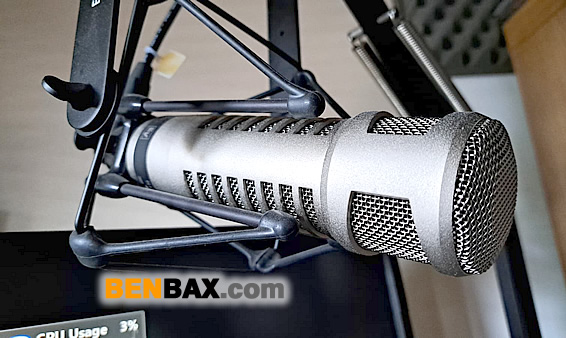
EV RE50
Type: Dynamic.
Polar Pattern:
Omnidirectional.
Frequency Repsonse: 80 -
13,000Hz.
Whilst not a voice-over microphone, the RE50 has a very
clear and transparent sound. An omnidirectional pattern means it will
pick up sound from all around, is not directional at all, and has no bass boosting 'proximity effect'. It is very popular with reporters on
TV and radio. I bought one of these too and will be testing it soon
and posting the review on here. More for your interest really, it's
not a voice-over microphone by any means, but may be good for location
work or interviews if you want some ambiance to be picked-up in the
recording. If I don't like it, they seem to keep their value on eBay
if it's in new condition. The RE50 used to
be all the rage on 1980s local TV news in its 'champagne' paint finish. The RE50B (with B suffix) is the black version. EV do not appear to make the original 'champagne' grey version any more. Omnidirectional microphone capsules do not suffer from the 'proximity effect' bass boost when close-miking.
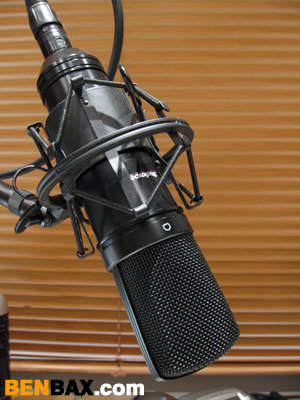
Studiospares S1000
Type:
Condenser. Polar Pattern: Cardioid. Frequency
Repsonse: 20 - 20,000Hz ? (no data available)
For less than £35 (in 2009), you can now own a good condenser
mic with a near ruler-flat frequency response! Spend another £20
on an elastic suspension, and you have a really nice condenser mic set-up.
It has a larger pick-up area than the AT2020, so you may need more acoustic
treatment in your room. But for that price, it's pretty faultless. I
find it has a very rich, warm sound to it without capturing too much
of the old 'moist mouth' noises that condensers can sometimes over-do.
I was disappointed by Studiospares' windshield for this mic I bought at the time. It was a mere 7mm thick
and cost £14.38 - and I sent it back. Instead, I bought a Rode WS2 windshield which also fits my AT2020 which is a proper rough much thicker rescinded foam windshield and only cost about £19.
You can buy this as a kit in a flightcase, and also another
version, the S1100 (with a flat grille top) which has two switches -
a bass roll-off and an omni switch (effectively converting the mic into
an omnidirectional one).
UPDATE Studiospares no longer sell these exact models (S1000, S1100) any more, but a single updated version. In 2018, the S1005 model which comes with the suspension mount was on sale for just £39. That's got to be worth a try at that kind of price!
I'm not sure whether this is available in the USA - the way
Studiospares describe it sounds like they specified each component themselves
eg. material for the grille, etc. and had it made in Asia, but you know
what factories in Asia are like and could have similar versions re-branded
for other companies. Who knows.
UPDATE In late 2024 Studiospares went into liquidation and was bought by gear4music, so these microphones will no longer be available. Online audio shops is a very crowded market these days with a race to the bottom on pricing.
Clockwise from top left: AT2020, S1000, SM57
Sennheiser MKH416
Type: Condenser.
Polar Pattern: Super cardioid / Shotgun.
Frequency Repsonse: 40 -
20,000Hz.
I really tortured myself about buying this one. So many experienced voice artists and sound engineers say this is not a good mic to use for voice over work. Whilst the MKH416 was never designed for voice-overs studios (it is for TV and film work with a camera, often outdoors), it appears to be the Americans who have persisted with this misnomer and so converse to its critics you hear people rave about it too.
Legendary VO Ernie Anderson can be seen on a YouTube video voicing promos for ABC television in 1989 with one of these inches away from his mouth, no headphones and instead the audio track of the promo he's voicing blaring loudly out of speakers in the same room! But what a voice he had - he'd sound good with any microphone! I had seen it as the main on-air mic on BBC Radio 2 in the 1990s (although I think they'd fitted it with a windshield from a much longer shotgun mic to act as a bit of end distance 'buffer') and with royals interviewing each other (below) to reduce room resonance and atmos even from the open window, etc. If you have a wonderful deep chocolatey voice, maybe this isn't the mic to choose to get the full rich sound of your pipes. Now I own one, I can appreciate why it is used for VO work - it is very 'direct sounding' and 'clear cutting' - despite a flat frequency response - which is indeed mentioned by its critics. I suppose they like it because it allows the voice to cut through any background music without having to EQ it.
So purchasing possibly my most expensive microphone (£700) was something I thought about for many months before deciding to do it. The reason I took the plunge was because of its directionality. I hoped it would give me the quality of a condenser but without the huge pickup area you'd get with a large diaphragm condenser that would pick up the computer fan and any room reverberation. Initially, I wasn't that convinced I'd made the right decision when putting it through my Mackie mixer and into my DBX 166xs compressor before going through my Audient iD14 and into the PC via USB. I couldn't seem to get a particularly fantastic sound out of it, and the gate of the compressor kept 'pumping' with every slight 'clunk' the microphone heard in the room. So I had to stand absolutely still when recording so that a knocked cable or rustle of clothing didn't open the gate. I regretted purchasing the microphone and introducing it to my setup at the same time as a new compressor and USB interface, because I was having to master 3 new modules in the chain - effectively the entire chain! However, I had an idea to plug the microphone directly into the Audient USB interface instead, bypassing the Mackie mixer and compressor/gate analogue side of the chain. What a difference! This was it - the magic combination to [possibly] rival my beloved SM57 analogue chain (mentioned on page 1). Then I thought I'd try plugging in my SM57 directly into the USB interface as well. Blam! Perfect sound. So this was the eureka moment when I realised that this was the way to do it from now on (early 2018). No more Mackie mixer and analogue compressor/limiter/gate. Just the microphone signal going directly into the computer via the USB interface, raw and unaltered. Then using the compressor/limiter functions of the audio editing software to make it sound just as good, if not better than before with the analogue chain. (Re: software - after 21 years of using Cool Edit, I started using Sound Forge Audio Studio which came free with some Sony video editing software. It stopped working and I now use the free Audient software)
I appreciate I've wandered off the point of this microphone review, but think the above chain setup is worthy of mention because it made such a difference to the sound of the mic. The MKH416 is a long microphone - a little longer than my full hand span, and thin. Initially I used the windshield with it, but because it is so very directional you can simply talk slightly off axis and you don't need the windshield. Just like Ernie Anderson! But without that voice...
I bought an elastic suspension mount for it, as it is mounted on a long gooseneck and clamp in my setup. With its directionality, you do have to remain fairly still in the 'sweet spot' of the pick-up. I would say it doesn't 'reject' sound from behind it / the sides as much as an SM57 or MD431 dynamic mics do, as it's generally more sensitive with being a condenser.
I must admit, I actually use the MKH416 now as my main voice recognition software microphone for my daily work writing hundreds of e-mails in place of the microphone I had used previously for this task - the Sennheiser Black Fire 531, above. I didn't have to retrain the software switching mics, and the accuracy is very good. I originally had it on a weighted desk stand with an 18 inch black gooseneck which has an XLR connector built into its end, but because of desk vibrations it's now on a gooseneck coming from a G-clamp stuck to a shelf near my desk. Because it's a condenser and needs phantom power, I purchased an Allen & Heath Zed 6 mixer (shown right) specifically for this microphone to use for voice recognition. I spent a long time researching which mixer to get as I didn't want one with a huge 'wall-wart' mains transformer. It's a very nicely built mixer, and I leave the microphone plugged in and mixer powered up and on 24/7. It also produces nowhere near as much heat as my Mackie mixer. The only downside is it doesn't have something like a 'tape out' to plug into my PC soundcard (like Mackies do) so I have to take the signal from the headphone output to my soundcard 'line in' instead as the balanced level output from the XLRs is obviously too high a signal.
Audio Technica AT4040
Type: Large diaphragm condenser.
Polar Pattern: Cardioid.
Frequency Repsonse: 20 -
20,000Hz.
Made in Japan, and popular in UK commercial radio stations in the 1990s, the AT4040 looks similar to the AT4033 but has a flatter frequency response, still with a slight boost in the high frequencies. Excellent and cleverly designed super fitting suspension mount. You even get a little storage bag dust cover thing with it to put over the mic in the studio when you're not using it.
Neumann TLM103
Type: Large diaphragm condenser.
Polar Pattern: Cardioid.
Frequency Repsonse: 20 -
20,000Hz.
What is it with the Germans and microphones? Again, another tortured purchase for me! “A considered purchase” (in other words, it's probably too expensive for what I do, but what are you saving all that money up for anyway? Food?!) in October 2019 at £840.
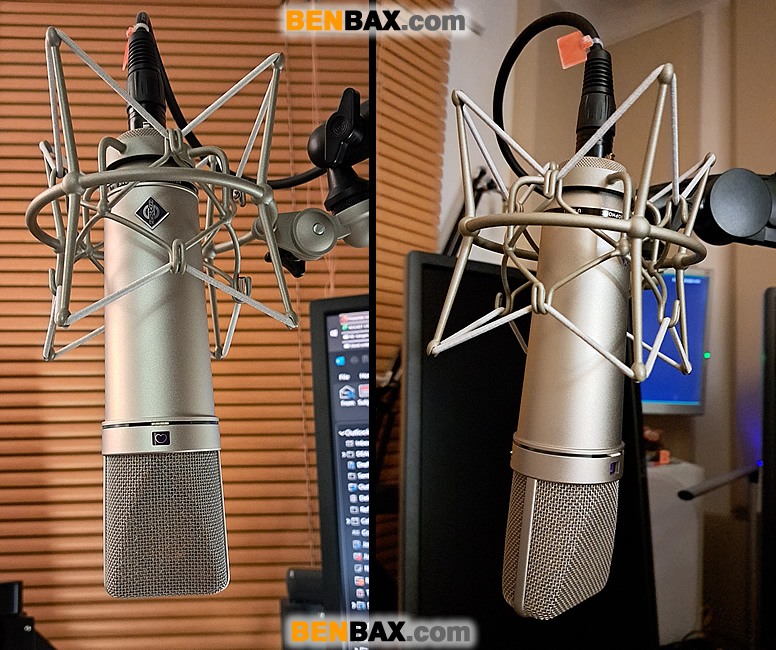
I had considered purchasing Neumann U87Ai (pictured right), with the idea being it's such an omnipresent microphone in recording studios and has been for 40+ years, that this would be the pinnacle of my microphone purchasing - for voice work, all you could do from then is purchase either outboard processing racks or some stupendous microphone preamp or amazing audio processing software. The U87 is most often used for vocals, speech recording, the main on-air mic for national radio stations, etc.
However, buying a microphone which cost more than my first car and that niggling feeling that perhaps the U87 is the price it is because people are simply willing to pay that for the kudos or because it has a reputation, rather than perhaps the sum of the components actually costing quite that much (?), especially relative to other microphones in the Neumann range, meant that I will not be buying the U87. For the moment at least! (oh dear - read on below...)
Anyway, the ‘poor man's’ U87 is perhaps the TLM103. Cosmetically, it effectively looks like a shortened version of the U87 in that it has the same mesh cage top, and a similar cylindrical body - just that the body is not as long. It's also about a 3rd of the price of a U87. Others have analysed its frequency response fairly scientifically (on YouTube at least) and state that although it does use the same capsule diaphragm as the U87, the frequency response graph, when compared, is indeed slightly different and a little ‘brighter’.
I first became aware of it when I spotted a 'stumpy U87' as the station microphone at Scala Radio, a national classical music radio station in the UK where it is used along with a Rycote elastic suspension mount which is a heck of a lot cheaper than the Neumann one and less spiky looking and sharp (you can hear Howard Stern chunter on in a YouTube clip about how dangerous his new Neumann mic suspension mount was which is why you will generally see him with a TLM 103 without a suspension mount, nor windshield which is why he can 'pop' sometimes).
The purchasing options are to buy the microphone in a wooden box with the SG3 stand mount included (not elastic suspension - just a metal ring piece that screws onto and holds the microphone at its bottom as per my photo above). Or you can buy the microphone without the wooden box but in a nice cardboard box with the official Neumann elastic suspension mount. The apparent price discrepancy between these two purchasing options, when working it out like a school maths question, suggests the cost of the wooden box is £164 value. I hope it's a bloody nice box!
It seems odd that you cannot appear to purchase the microphone and the basic stand mount without this not inexpensive wooden box. Which again makes your mind wonder if they are deliberately trying to charge as much as possible so that it appears as a premium product and not to cheapen their name and have their mics compared with Chinese made units? There will no doubt be some economics/marketing rhetoric behind it - those Germans aren't daft.
The U87Ai was released in 1986 as an updated version of the original U87 which was itself introduced in 1967.
The TLM 103 hasn't been around anywhere near as long as the U87, being introduced in 1997.
Aside from the large diaphragm being the same as those in the U87, the mic has no bass roll off switch or any switching at all, but does have very low self noise making it among the quietest microphones out there. (7dBA, but the winner might be a Rode NT1 at 4.5dBA).
I'll keep this page updated with what I find from using the TLM103. Where do they get these names from?
This chap (not me!) liked the TLM103 enough to have a large stock product picture of it tattooed on him...including suspension mount...
...
now, I do like microphones, but...yikes!
Neumann U87Ai
Type: Large diaphragm condenser.
Polar Pattern: Cardioid / Omni / Figure of 8
Frequency Repsonse: 20 -
20,000Hz.
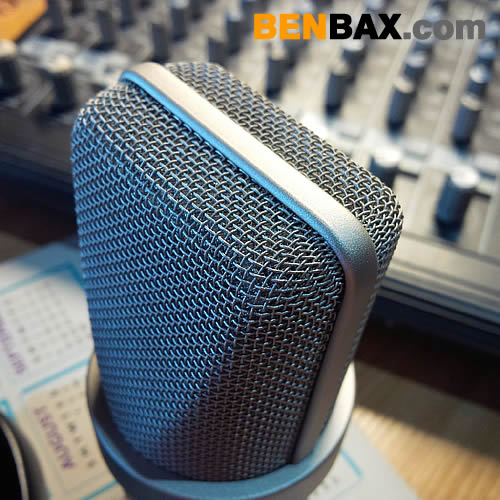
Oh dear. I bought one. Everyone was always going on about them and 'oooh aren't they lovely' etc.
I tortured myself for years about buying one, whether I could qualify the expense, how would I actually feel if I did get one? Would I feel I'd paid over the odds?, etc.
But I bought one. Don't hate me. It cost more than my first car.
So now I have a Neumann U87 Ai on my desk hanging in front of my face all day for taking phone calls down my telephone balance units.
Do callers appreciate that? No. They don't even know. It's ridiculous really. Almost obscene. But not quite. Because those same callers essentially helped me buy it. And the bonkers thing is that I don't even hear it because the mic feed goes straight to those TBUs and not through any headphones etc. for me to monitor. As I type this, I have realised that I actually HAVE NEVER EVEN HEARD WHAT I SOUND LIKE THROUGH IT, TWO YEARS LATER. Utterly ridiculous. If you've read to this point, you may be wondering what sort of rubbish microphone review website this is if the writer hasn't even heard what the microphone sounds like...and you'd be right to do so.
It is aesthetically pleasing. I handle it very carefully knowing it cost £2,359 in 2024. Although it looks lovely and iconic, I usually have the proper windshield over it because Neumann's instructions make you completely paranoid about dust on the diaphragm or me sneezing on it or whatever. But sometimes I just like to admire it, live dangerously and have it like the photo above. And make sure I don't sneeze into it.
The Neumann suspension mount is a health & safety nightmare - pointy, sharp metal spiky bits - eight of them - four of which are right where your face is. Poorly considered, and really on the verge of contemptuous to the user. Lumps of Blu-Tak on each to prevent accidental gouging of the flesh does degrade the aesthetics somewhat.
I think the microphone collection is now complete. I really can't think of any other mic to buy that would top what I already have that could top this. (Update: Maybe a Shure SM5B if the windshield isn't all yukky!? A microphone that is a payphone handset (these exist), that Neumann dynamic broadcast one?)
On a philosophical note, my accountant told me you don't always have to 'buy stuff' and maybe he's right. There is a lot to be said for the 'thrill of the chase' or wanting things and not necessarily always buying them, as those things can sometimes be disappointing. A bit like noticing an attractive person in the street and wistfully dreaming about what it would be like to date them, to actually being in a relationship with them and ...realising they're not quite the catch you perhaps thought! Getting a bit deep here now so ... back to microphones!
The way I was talking about that Neumann would make you think that was the end of it in terms of microphone purchasing! Well, alas, I just can't help myself...
Electro-Voice RE27
Type: Dynamic
Polar Pattern: Cardioid
Frequency Repsonse: 45 -
20,000Hz.
EV RE27 in the 309A suspension mount
Purchased entirely on the basis of seeing a video from the mid-90s showing Don Imus change the standard RE20 microphone at the WFAN studios for his own RE27 in some old C-SPAN videos Ellis B. Feaster kindly uploaded to YouTube. At the end of the show, the I-Man unplugs it, reconnects the RE20 back for the next host and pops the RE27 into his little man handbag.
It has been noted in other microphone reviews as being exceptionally harsh in the top end, to the extent that you must engage the top-end roll-off for it to be in any way usable. I notice that they are now sadly made in Mexico rather than the USA. I assume US-made microphones will become a bit of a collector's item as production seems to be ever more relocating to Mexico or China.
Technically, the RE27N/D is a cardioid Variable-D dynamic with a 45-20,000 Hz response and a neodymium element giving it 6 dB more sensitivity than the RE20. Its three switches provide two degrees of bass roll-off and a 3 dB reduction in the upper-frequency rise, which is the official means of making it rather less excitable.
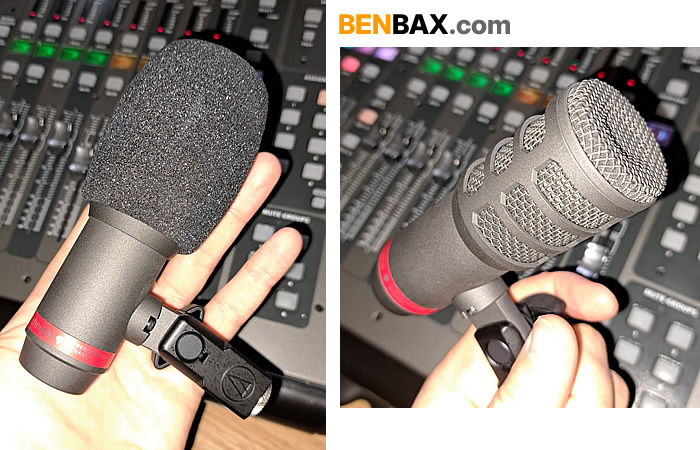
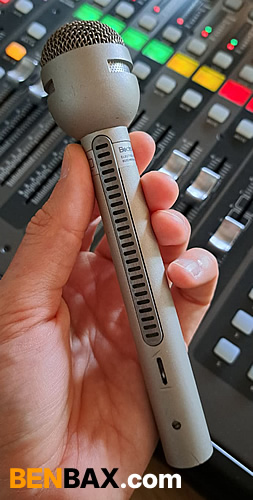
I believe now discontinued, I imported it from Japan and it is essentially a compact snare drum and high-SPL instrument microphone. However, it performs very well on speech and has a certain air of Shure SM56 about it having the stand-mount built in. Shure really should bring that model back!
It is a reassuringly chunky 390g hypercardioid dynamic with a frequency response of 30-15,000 Hz. Audio-Technica's own description even recommends it for close-up vocals and dialogue, so using it for speech is rather less inappropriate than it initially appears. Very solidly built - a thwack from a drum stick won't damage it.
AT ATM25
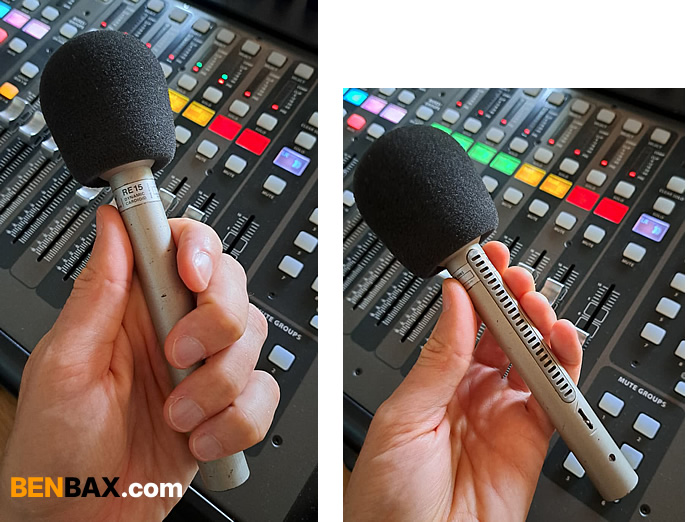
Electro-Voice RE15
Type: Dynamic
Polar Pattern: Super Cardioid
Frequency Repsonse: 80 -
15,000Hz.
Uh-huh. The voice of Elvis was heard through Electro-Voice microphones extensively throughout the 60s and 70s - his Aloha from Hawaii live broadcast used the RE15, as did tours and his Vegas residency around that period. These microphones command hellish sums on eBay, possibly due to the visual Elvis connection.
I imported my unit, which was originally used in a church in the southern states of the US and came with the suspension mount and original metal box. Although perhaps a little vintage-sounding given its age, it probably isn't necessarily suitable as a voice-over microphone. It's very small, though, and definitely has a unique charm about it, especially with the Variable-D proximity-effect reduction nowadays more closely associated with the much, much larger and heavier RE20 and RE27 models.
I also regrettably purchased the RE10 model, with many eBay sellers stating that it is very much like the RE15 but made to lower tolerances, or even rejected from the RE15 production line. There seems to be no authoritative evidence for that entertaining story. Electro-Voice's own information describes it simply as a similar, slightly lower-specification model. The one I bought sounds crap, despite supposedly having been refurbished. There is nothing below 200 Hz, making it unusable for most recording purposes.
The RE15's published response is 80-15,000 Hz, compared with 90-13,000 Hz for the RE10. Both are Variable-D supercardioid dynamics with switchable bass tilt, so an RE10 producing virtually nothing below 200 Hz is not merely behaving like an RE10 - mine is either still faulty or has been very strangely refurbished.
My RE15 with the Elvis inspired Aloha windshield fitted.
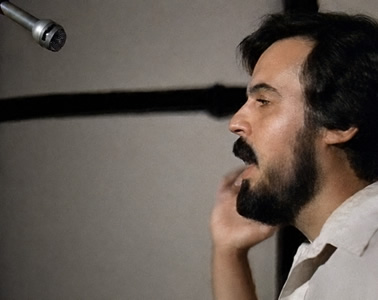
The voice of Mickey Mouse recording dialogue for the Christmas Carol film in 1982/3.
Not sure if this was a recreation for a 'making of' documentary, or if the dialogue for the film was actually recorded with an RE15...
My EV RE10, in jolly good nick, but sounding a bit naff if you like hearing frequencies below 200Hz
Now we enter the world of AI as a wingman, advising me whether or not to purchase certain microphones. A very dangerous combination! It knows exactly which models I already have and what would make good additions to the collection.
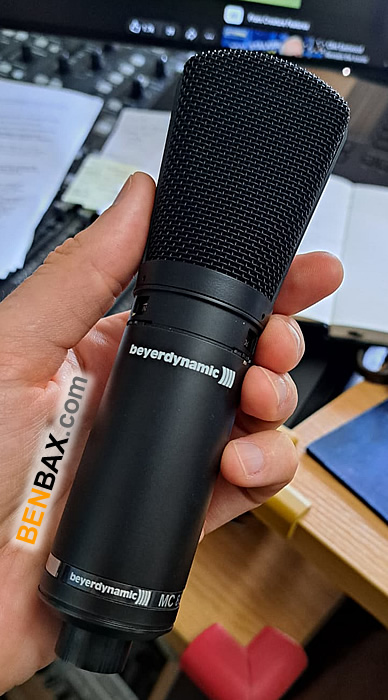
As someone whose interest in radio was catalysed by Century Radio between 1994 and 1998, I wanted this model because it was their main on-air microphone. It was also used in the studios of Scot FM. It does not seem to have been a particularly prolific or popular microphone elsewhere, although a different model in the range which is theoretically still made but not listed on their website, the MC840 is in all the Global/Capital Radio studios down in Leicester Square. I always thought those were MC740s. Maybe that was pre-2006..
Introduced in 1993, the MC834 is a fixed-cardioid, side-address condenser intended as a simpler and more affordable alternative to the multi-pattern MC740. It has a notably uncoloured response, switchable low-frequency roll-off and can withstand up to 150 dB SPL with the attenuation engaged, making it equally suited to voice or something brutally loud. Interestingly, it has a wind shield foam inside the grille. I like it.
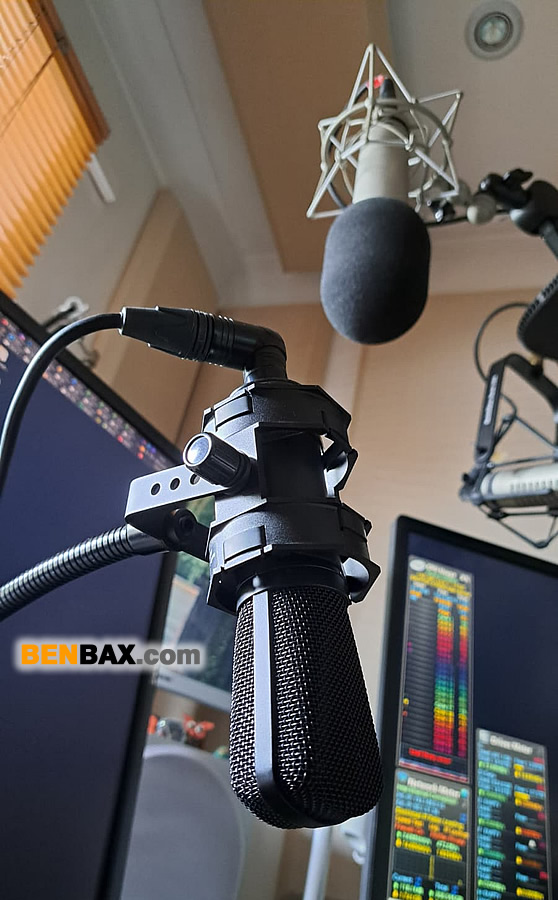
The Beyer MC834 in an AT8415 suspension mount which fits well, with U87 looming above it
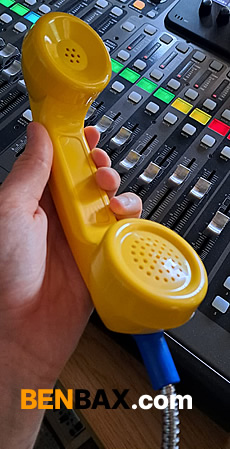
Trash Talk Payphone Microphone
Type: Dynamic.
Polar Pattern: ???
Frequency Repsonse: 300 -
3,400Hz.
Utterly ridiculous, of course, but Instagram seems to present me with adverts it knows I will fall for. This is a microphone made from a payphone handset, complete with the somewhat ridiculous metal vandal-proof spiral cable protector attached to it, which I hadn't quite appreciated when ordering.
It doesn't have anything in the earpiece part - just a dynamic microphone with suitable frequency restriction in the mouthpiece. It gives the classic telephone audio-range sound. It is obviously very well built and made in Bohemia, New York, although I purchased it from a UK distributor. This worked out at pretty much the same price once the shipping, import duties and other costs of buying it directly from New York were taken into account.
Technically, it is a standard dynamic microphone with a deliberately restricted frequency response of 300-3,400 Hz and an impedance of approximately 150 ohms. Its 32-inch metal-shielded cable terminates in an unbalanced male XLR, producing the genuine telephone sound without needing any plug-ins or processing.
I opted for the yellow version. It is available in a number of different colours, including black, green, orange and red. I thought black would make it look too much like everything else on my desk.
I am one of those people who longs for the return of the beige box and the inherent reflected light from it, which was part of the idea - to lighten up a workplace. Beige and white equipment also doesn't seem to gather dust as visibly as the horrendous black boxes we appear unable to escape from these days. The only white things in my office, apart from me, are the monitor arms, microphone arms and speakers. I could class the walls of the room in that as well, I suppose.
Can you tell I'm waffling? I'm not sure how many people really read this website now. When I first started, I used to get emails every couple of days from people asking for advice. In fairness, microphone reviews on YouTube have now usurped this text-based diatribe, as at least you can hear what the microphone sounds like.
So, like a tree falling in a wood, will anyone read this...?
Rode Podcaster and other microphones
(2009) Aimed
specifically for podcasting, Australian company Rode have invented an
innovative microphone that negates the need for a mixer altogether.
It's called the Rode Podcaster, costs around £149,
and is a dynamic microphone that plugs straight into your PC's USB socket.
It has a built-in headphone amp and volume control, so you just plug
your headphones into the side of the mic itself. Certainly borrowing
some aesthetic design from the EV RE20 but in Apple-style white, it
has a generous 5 metre USB cable. It certainly seems to be the most
convenient way to record podcasts direct to your PC if you don't want
to buy a mixing desk, but does lack flexibility of control (e.g. tone,
compression, limiting) for more critical applications, and the frequency
response is quite limited at the high-end.
Legendary voice-over artist Corey Burton once posted on his message
board, "I do not recommend "plug'n'play" USB output
microphones, except for the most rudimentary news or podcasting applications,
where fair reproduction of plain speaking voices and location sound
"actualities" is all that's necessary. For character voices
and VO work, even an old Shure SM-57 with a high fidelity preamp will
do a better job at capturing a range of tone and texture, than the dry,
lackluster, or sometimes "murky" qualities I've heard from
even the better USB microphones currently on the market."
(from coreyburton.com)
Corey does a lot of work for Disney animations and theme parks, and
whilst he understandably uses the best equipment available, his
mention of an SM57 as a starting off point is worth noting. Please see
page 1 for my review of the SM57.
My prediction back in 2005 was that audio equipment manufacturers would
begin to offer 'bundles' of equipment and software in a convenient box
to appeal to podcasters - an ever-increasing market. Behringer had already
announced a bundle that includes a microphone, mixer and headphones.
The mixer plugs straight into the USB port. It's a new market for them,
and in a similar way that blogs seemed to go, many creators will sign up to do podcasts
to begin with, then after realising only 2 people downloaded it, they won't be bothered to continue after the initial
excitement (unless you're a geek on a particular topic or an experienced
talk radio presenter, I really don't know what people talk about on
them!). As I write this particular paragraph at the end of 2009,
podcasting wasn't such an in-term anymore, with most amateur podcasters
fading away, and edited radio programmes or discussions from newspaper groups being the mainstay of podcast
content.
The Rode M3 is a new low cost condenser mic from Rode.
Looking a lot like the AKG C1000S, it uses a PP3 9v battery and at £75
sounds like pretty good value for anyone wanting a low cost mic for
their podcast recordings, although it's not USB direct.
Rode also introduced the Procaster (picture left) in 2009,
a black version of the podcaster body above, but seemingly going straight
after the RE20 market. It has an attractive price, but again not USB
direct.
Even EV introduced the RE320, a lower cost mic based on their RE20. It's not USB, but for folks who want an RE20 but don't want to spend quite that much, it's the next best thing (but made in China). Please support Western manufacturing.
Audio Technica have introduced the BP40 (pictured right), a dynamic broadcast microphone that delivers rich, natural, "condenser-like" sound. Perhaps aimed as an alternative to the Shure SM7B? It's hypercardioid with a frequency response of 50-16,000 Hz.
Beyerdynamic's M99 is another large diaphragm dynamic aimed at broadcast, with the same polar pattern and 30 - 18,000 Hz frequency response. (below right)
And Neumann are getting in on the 'dynamic' act with their BCM 705. Using the same housing as one of their condenser mics aimed at the radio studio market and taken up with enthusiasm by some BBC local radio it seems (well, it's not their money, is it!?). 20 - 20,000 Hz response. Neumann describe the mic's pop screen "efficiently prevents unwanted particles, from respiratory moisture, nicotine, to food remnants, from settling on the diaphragm." Yuck!
See my previous review of the Sennheiser MD431 to find out where the mic capsule comes from!
Retro Style Microphones
L-R: Shure 55SH II, DAP VM-60, DM-065 'Nostalgic' vocal mic
Whilst they do look very nice and shiny, and I am certainly
partial to them aesthetically, I'm not really sure if they're great
for voice-work. As they have so much solid metal caging around the
microphone capsule, they tend to be, in my opinion, sometimes quite 'metal'
sounding and not very 'warm'. They're most often used as props or period
mics on occassional vocal stage performances on stage or TV. They're
pretty cheap to buy if you do want one. I've certainly found them to be a great talking point
in your studio - everyone homes in on mine as they first thing they
notice in the room. They can also look like you've won some recording awards! (see below)
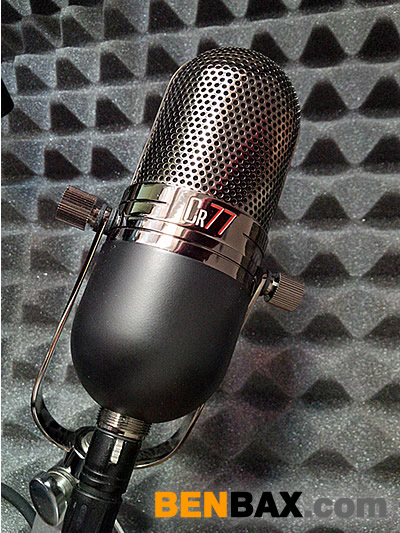
MXL CR77
Type: Dynamic.
Polar Pattern:
Super Cardioid.
Frequency Repsonse:
50 Hz - 14,000 Hz
My MXL CR77 (pictured right)
looks great. It's actually aimed for stage use, as it's in fact
a dynamic capsule inside, although the design would suggest it is a vintage ribbon mic. The pick-up pattern is quite wide even though
it's a super-cardioid and you do have to be pretty close to the grille.
The
black chrome finish is not for those who have OCD about fingerprints!
(although MXL do provide a polishing cloth with the mic!)
Its look (and possibly even model name) are surely inspired by the
RCA 77DX which Larry King used on his desk (albeit as a prop in his case). I use it as an ornament and haven't used it for many years.
Microphones, continued...
Frequency Response Graphs
You can see why the C414 is a popular mic.
RE20
45 - 18kHz
AKG C414 in hypercardioid pattern
20 - 20kHz
ATM31a
30 - 20kHz
AT2020
20 - 20kHz
SM7B
50 - 20kHz
SM57
40 - 15kHz
Shure Beta 87A
50 - 20kHz
MK319
20 - 18kHz
Shure SM81
20 - 20kHz
Sennheiser MD431 II
40 - 16kHz
Sennheiser MD421 II
30 - 17kHz
Beyer M201
40 - 18kHz
It's truly amazing to see prices for some microphones drop by literally 80%
over the course of 10 years.
Microphones
- in conclusion...
From those I know, most full-time voice-overs in the UK use Neumann U87
/ TLM103, Rode NT1, AKG C414 TLII, or AT condensers for true pick-up of their
voice which can then be EQed and processed later using software or outboard
processing boxes.
Then at BBC Radio 4 and BBC local radio they mostly
used Beyerdynamic M201s (hypercardioid) which was a unique choice, but now TLM103s (local) and C414s (R4).
In-vision podcasters seem to predominantly use Shure SM7Bs I suppose as it looks more aesthetically pleasing than the SM57 with big windshield. Shure must sell an absolute ton of these now compared with 30 years ago!
There's
a huge selection of condensers manufactured in the Far East whose prices
are around that of popular dynamic stage mics. This has brought accurate
sound recording within reach of many more people than 20 years ago when
the cheapest good condenser would have cost four-figures (£). I've
used Neumann U87s (pictured left), M149s (which cost more than my car)
in voice-over booths, and really didn't find them hugely different in
clarity to my AT2020 to warrant spending such a large amount more on them
to initially purchase - but perhaps my ears are not as trained as recording
and sound engineers - there must be a reason why people have 'favourite'
mics they prefer over others.
My current favourite microphones are the AT2020 and the MD441, but if
you're starting out or just doing podcasts, an SM57 is an excellent buy (along with a Cloud Lifter) or a Rode NT1 with suitable phantom power supply. Along with a professional USB audio interface to connect it digitally to your PC.


 Type:
Condenser.
Type:
Condenser. 


 I must admit, I actually use the MKH416 now as my main



 Oh dear. I bought one. Everyone was always going on about them and 'oooh aren't they lovely' etc.
 Utterly ridiculous, of course, but Instagram seems to present me with adverts it knows I will fall for. This is a microphone made from a payphone handset, complete with the somewhat ridiculous metal vandal-proof spiral cable protector attached to it, which I hadn't quite appreciated when ordering.
 Aimed
specifically for podcasting, Australian company Rode have invented an
innovative microphone that negates the need for a mixer altogether.
It's called the Rode Podcaster, costs around £149,
and is a dynamic microphone that plugs straight into your PC's USB socket.
It has a built-in headphone amp and volume control, so you just plug
your headphones into the side of the mic itself. Certainly borrowing
some aesthetic design from the EV RE20 but in Apple-style white, it
has a generous 5 metre USB cable. It certainly seems to be the most
convenient way to record podcasts direct to your PC if you don't want
to buy a mixing desk, but does lack flexibility of control (e.g. tone,
compression, limiting) for more critical applications, and the frequency
response is quite limited at the high-end.
Aimed
specifically for podcasting, Australian company Rode have invented an
innovative microphone that negates the need for a mixer altogether.
It's called the Rode Podcaster, costs around £149,
and is a dynamic microphone that plugs straight into your PC's USB socket.
It has a built-in headphone amp and volume control, so you just plug
your headphones into the side of the mic itself. Certainly borrowing
some aesthetic design from the EV RE20 but in Apple-style white, it
has a generous 5 metre USB cable. It certainly seems to be the most
convenient way to record podcasts direct to your PC if you don't want
to buy a mixing desk, but does lack flexibility of control (e.g. tone,
compression, limiting) for more critical applications, and the frequency
response is quite limited at the high-end. 2009,
podcasting wasn't such an in-term anymore, with most amateur podcasters
fading away, and edited radio programmes or discussions from newspaper groups being the mainstay of podcast
content.
2009,
podcasting wasn't such an in-term anymore, with most amateur podcasters
fading away, and edited radio programmes or discussions from newspaper groups being the mainstay of podcast
content. 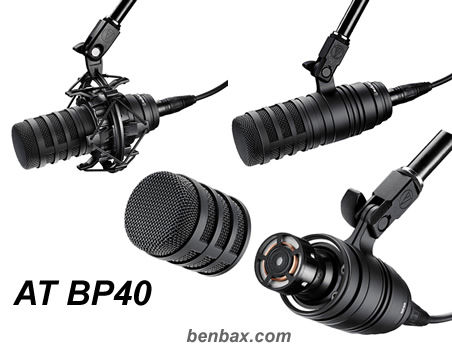


 The
black chrome finish is not for those who have OCD about fingerprints!
The
black chrome finish is not for those who have OCD about fingerprints!